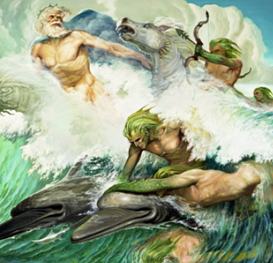
Original oil painting. Painted in Portland, Oregon – 1957. Done in the classic Montyne style. The attention to little details are striking. Observe the water droplets on the green leafs and they almost jump out from the canvas. His knowledge of the human body plays an important part in the harmony of this painting. The purity and innocence of Tinkerbelle is felt by the artist genius. Everyone wants to touch a star, but only in our dreams. Paintings can be those dreams.
This subject was used for two paintings: Geronimo in Red and Geronimo in Blue. The history on Geronimo is filled with tears. A leader of the Bedonkohe Apache who fought against Mexico and the United States for their expansion into Apache tribal lands, began his revenge after a company of Mexican soldiers killed his mother, wife, and three children in 1858. What were raids filled with vengeance against Mexicans, and then a career as a war chief, ended with his surrender to U.S. authorities after a lengthy pursuit. Geronimo became a celebrity, never allowed to return to the land of his birth. He regretted his act of surrender and claimed the conditions he made at the time he capitulated were never honored.
Montyne respected this history and said, “One wrong act against the innocent will created a life of collateral damage.” Geronimo in Red was painted in hours on Masonite hardboard. He then took a 1947 Lesto jigsaw and cut off the edges to all four sides of the painting, creating a rustic look – the way Montyne envisioned the war chief. The work was finished with a deep Lacquer, adding to its rough and war weary look. Like Geronimo, a tired Montyne created this painting. We have collected information that leads us to believe he did this work for the 1974 Jockey Club exhibit. This was an art show and exposition that exclusively presented only Montyne’s artwork. The painting has survived and remains part of the Montyne collection.
Original oil painting. Painted in Sparks, Nevada – 1986. The focus on this subject was the water. This would unknowingly be one of Montyne’s last commissions. The artists’ stepson Tony Evans asked Montyne to create this work in his home. This is one of Montyne’s themes, if not his passion, belief, and artistic principals. The Spanish Galleon, a former large 3 or 4 masted ship, developed during the fifteenth and sixteenth centuries, as a merchant vessel for commerce and war was the subject chosen by the artist. The Spanish Galleon resembled those of the oared galley; and they were built with emphasis on beauty. The colorful sails and detail to the haul made a Spanish Galleon very recognizable. Montyne completed this work in three days, as he was known for his promptness and ability to create works of art in record time. The two aspects Montyne concentrated on for this work was experience and a record of the past. Montyne wanted the viewer to feel the power, drama, and beauty of the Spanish Galleon, and at the same time, through the pure form – in the visual arts – the relationships among the colour, lines, and masses in space. But, truly it is the water in this work that is amazing. Montyne placed the Galleon on the crest of a wave, as the vessel was ‘Bound for Glory’. Through the water the viewer can see the haul of the ship, it is overcome by the power of nature. In Bound for Glory we see how man creates wonderful massive works of both necessity and beauty, and yet is still humbled by the forces of nature – or the hands of God…
Montyne’s knowledge of history was apparent by the many subjects he used to create a work of art. The Vikings were Norse explorers, warriors, merchants, and pirates. Modern views of the Vikings as violent intrepid adventurers have been romanticized through the ages, taking root in the 18th century. In texts such as the Icelandic Sagas, the phrase “To go Viking” implies participation in raiding activity or piracy, not just simple seaborne missions of trade and commerce. These Norsemen used their famed long-ships to travel in the period of the Viking expansion – known as the Viking age. Montyne captures these romantic myths of adventure and discovery in this wonderful work.
Montyne. It is said that many artist suffer dearly by living a life denied of its simplest necessities. Genius makes the foolish choice to sacrifice their lives during the pursuit of discovery, creativity and art. The artist is more often frowned upon as a dreamer, rather than as the hands of civilization, and perhaps the true reason why we are all alive. The starving artist is the cliché – a terrible sentence that describes the ignorant reasoning in a society that is embellished and smothered by the arts, its science, and technology – hypocrisy for those that not make the journy but live by its reward.
Without the artist we would be as mundane as the black that fills the emptiness’ of space. Every part of our modern world is full of the artist work, whether it is from a painter, doctor, or scientist it lives because of sacrifice. We are able to live in a world far better than what any of our antecedents could have ever imagined. But yet, like Vincent van Gogh, the true artist is nearly never honestly rewarded until society catches-up – and by then the artist is often gone. What is left is a responsible world scrambling the earth for the art; society finally sees the work – it becomes priceless.
We give respect to the person with the most money, and with that success it is priceless art where the cash goes. Bank accounts will be filled with gold and silver. Leaders and famous faces will come and go. The world will constantly change, but in the very end it will be our art that creates our legacy – “Art Makes Us Immortal”.
With this in mind, how often is genius denied? How many times is the world set back, stagnant because societies priorities are on living for power and money? Nevertheless, this is an old fact. The ability to create anything is a miracle, and with this truth we adore the genius in every one of us.
Montyne made the many sacrifices to create his work. Every piece is interesting accompanied by a story – it is filled with his life. This website is a starting point for a message the artist wanted the world to receive, “There are many people who play at the game of art, play at life. The serious and true artist works three jobs. They understand that to create a work of art takes a lot of hard work – it takes sacrifice. And – in one way the genius sacrifices their life for our success, benefit, and pleasure.”
Please discover the many works by Montyne. We too are constantly discovering and collecting this art, so it can be presented on this wonderful site for anyone to enjoy. Discover Montyne – be a Montyne and let the genius in you shine.